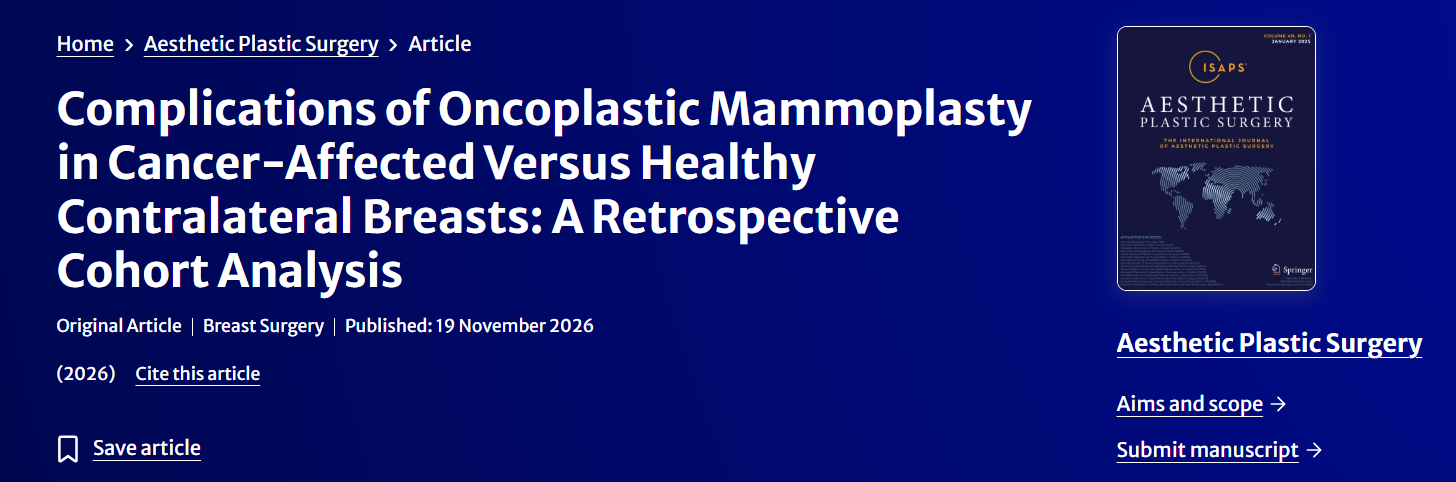
نام ژورنال | Aesthetic Plastic Surgery |
سال پابلیش | 2026 |
ایمپکت فکتور / Impact Factor | 2.7 |
چهارک مجله / Journal Quartile | Q1 |
نوع پابلیش ژورنال / Type of Publication | Hybrid Open Access |
ناشر مجله / Publisher | Springer Nature (Springer New York) |
کشور | United States of America |
نوع مقاله | Original Article |
SJR (SCImago Journal Rank) | 0.907 |
Abstract
Introduction
Although oncoplastic breast-conserving surgery (OBCS) is increasingly utilized for large-volume resections, comparative data on postoperative complications between the affected and contralateral breasts remain scarce. This study aimed to evaluate surgical morbidity between the two breasts following oncoplastic mammoplasty, alongside a secondary assessment of oncologic safety.
Method
This retrospective observational study included 229 female breast cancer patients treated at Rasul Akram Hospital and Aziminezhadan Breast Clinic, Tehran, Iran (2005–2021; outcome assessment 2021–2023). Each patient underwent oncoplastic breast-conserving surgery on the tumor-bearing breast and reduction mammoplasty on the contralateral healthy breast for symmetrization, enabling a direct within-patient comparison. Because each patient served as her own internal control, systemic risk factors were inherently matched. Paired statistical methods (McNemar and McNemar-Bowker tests) were used to compare complications and surgical variables between the two breasts.
Results
Postoperative complications were significantly higher in the cancer-affected breast (92.00% vs. 99.56% complication-free; P < 0.001), with major complications occurring exclusively on the tumor-bearing side (5.33%). Resection volumes were comparable between sides (P = 0.335), and secondary oncologic outcomes demonstrated a 97.38% negative margin rate and a 0.87% local recurrence rate.
Conclusion
Despite higher complication rates in the cancer-affected breast, overall morbidity remained low and oncologically safe, supporting oncoplastic mammoplasty as a feasible and safe option even for patients with high BMI and comorbidities.
https://link.springer.com/article/10.1007/s00266-026-06425-7